


Heading 1


Marco Polo Expeditions.
Winter Loop, 2027
Field Report — Vol. 01
31.44°N, 78.06°E — SPITI VALLEY, HIMACHAL PRADESH
...Where Light Meets Winter
20 - 28 JANUARY 2027
9
DAYS IN HIMALAYA
-10° TO -25°C
TEMP RANGE
DEEP WINTER
SEASON
CHD ↔ CHD
ROUTE
Altitude Profile — The Nine-Day Climb
APPROXIMATE ELEVATION PER STOP, METERS ABOVE SEA LEVEL. THE LOOP CLIMBS STEADILY FROM CHANDIGARH BEFORE PEAKING AROUND KAZA AND KOMIC.
4,587M
4,166M
2,708M
350M
2,960M
3,280M
3,800M
3,800M
2,708M
D1 CHD
D1 NKD
D2 KLP
D3 TABO
D4 KAZA
D5 KEY
D6 KOMIC
D7 PIN
D8 NKD
Field Entry — 00
"There's a point past Nako where the last tree disappears, and the valley stops pretending to be anything but stone, snow, and sky."
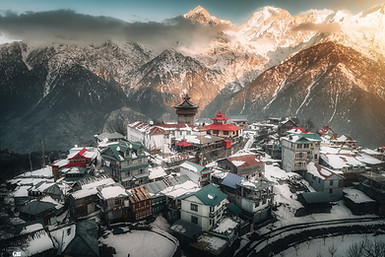
Winter turns Spiti into a different subject entirely not the high-desert brown of summer, but a valley reduced to white and shadow, where Key Monastery stands almost alone against the snow, and villages like Langza and Komic shrink to a few dark roofs in an ocean of white. Temperatures fall to -25°C before sunrise. The nine days that follow are less a checklist of viewpoints and more a slow negotiation with cold, altitude, and weather that changes the plan as often as it confirms it.
Field Reports — Day By Day
Chandigarh → Narkanda → Kalpa → Tabo → Kaza → Pin Valley → Tabo → Narkanda → Chandigarh

DAY
01
Where Green Turns White
We leave the plains behind and begin climbing into the winter Himalaya. Somewhere beyond Kufri, the forest starts holding snow, the air becomes sharper, and the landscape slowly loses its colour.
Narkanda is our first pause a place between two worlds. There is still forest here, still the familiar green of the mountains, but winter has already begun to take over.
As the light falls, we slow down for our first frames of snow-covered forests and open ridgelines.
Photography Checklist
-
Snow-Line Forest
-
Open Ridgeline At Dusk

DAY
02
Photography Checklist
-
Kinnaur Kailash
-
Kinnauri Architecture

DAY
03
Stone And Silence
Today the Himalaya begins to lose its trees.
The road climbs towards Nako, where the lake freezes and the landscape starts becoming almost monochromatic. Beyond Nako, the familiar mountain landscape gives way to something much more severe dry cliffs, enormous open spaces and snow settling into every fold of the valley.
This is where Spiti begins to feel less like a destination and more like another planet.
By evening we reach Tabo, where the ancient monastery sits quietly against the winter landscape.
Photography Checklist
-
Frozen Nako Lake
-
High-Altitude Desert

DAY
04
The Cold Desert Begins
We begin the morning inside one of Spiti’s oldest cultural landscapes.
Tabo’s monastery is not grand in the conventional sense. Its beauty is quieter earth walls, dark interiors, ancient paintings and caves disappearing into the cliffs above.
Later, the road takes us towards Dhankar, where the monastery appears almost impossibly balanced above the valley.
By evening we reach Kaza. The landscape outside is white and silent; inside, the warmth of the village becomes part of the experience.
Photography Checklist
-
Tabo Monastery & Caves
-
Dhankar Monastery

DAY
05
The Hero Frame
There are places that look familiar in photographs, but feel completely different when winter gets hold of them.
Key Monastery is one of them.
We head out early, when the valley is still blue and the first light begins touching the snow. The monastery rises above the Spiti River like a small, improbable structure in an enormous white landscape.
Later we continue towards Chicham, where the road crosses one of the highest bridges in the region and the valley opens beneath us.
This is one of the days where we simply stay with the landscape waiting for the right light rather than moving from one viewpoint to another.
Photography Checklist
-
Key Monastery
-
Chicham Bridge

DAY
06
Villages Of White
The higher we climb, the smaller the villages become.
At Langza, the Buddha looks across a landscape almost completely stripped of colour. Houses disappear into the snow and the mountains become enormous walls of white and shadow.
From Langza we continue towards Komic and Hikkim some of the highest inhabited places in the region.
Winter reduces these villages to their simplest form: a few homes, a monastery, prayer flags, footprints in the snow.
It is perhaps the purest expression of the white desert.
Photography Checklist
-
Langza Buddha
-
Komic & Hikkim

DAY
07
Frozen Pin River
We leave Kaza and turn towards Pin Valley.
The valley becomes narrower as we move deeper inside. The river is largely frozen, the slopes are covered in snow, and the usual movement of summer has almost disappeared.
This is a day for slower photographs layers of mountains, frozen water, tracks in the snow and the small traces of life that remain in the valley through winter.
Pin is also one of the landscapes where snow leopard habitat begins to feel very real. We will look, observe and photograph the landscape, but we never promise a sighting.
Photography Checklist
-
Frozen Pin River
-
Snow Leopard Habitat Landscapes
DAY
08
The Buffer Day
Today is deliberately different.
Winter does not always follow an itinerary, and this day gives the expedition room to breathe.
If weather has changed our plans earlier in the journey, this is where we use the time. Otherwise, we simply begin the long journey back through the landscape we crossed a few days earlier seeing it now with different eyes.
The colours slowly return as we descend towards Kinnaur and eventually the forests of Narkanda.
Field Note
If Day 6 or 7 lost time to weather, this is where it's made up.

DAY
09
What Remains
Today is deliberately different.
Winter does not always follow an itinerary, and this day gives the expedition room to breathe.
If weather has changed our plans earlier in the journey, this is where we use the time. Otherwise, we simply begin the long journey back through the landscape we crossed a few days earlier seeing it now with different eyes.
The colours slowly return as we descend towards Kinnaur and eventually the forests of Narkanda.
Field Note
Keep a comfortable buffer for evening flights winter roads don't run on schedule.
Field Entry — 01
Who This Trip Is For
Landscape Photographers
Minimalist
Framers
Extreme Cold Travelers
Patient
Observers
Seekers Of
Silence


Meet Your Expedition Leader
Leading this expedition is Ganesh Bagal, a professional landscape photographer and photography educator with over 15 years of experience.
Having led multiple photography expeditions across Spiti Valley, Ganesh has spent years exploring its remote villages, high-altitude landscapes, monasteries, and night skies. His experience in the region ensures participants are at the right locations, at the right time, to make the most of Spiti's unique photographic opportunities.
His work has been recognized with Tamron Photographer of the Year (2015) and published in National Geographic, Sanctuary Asia, and several other publications. He has also served as a jury member for photography competitions, including contests organized by India's Ministry of Culture.
Ganesh proudly represents Sony Alpha, Peak Design, Haida Filters, Think Tank Photo, Godox, and Google Pixel, combining years of field experience with practical guidance to help participants create meaningful images while experiencing one of the Himalayas' most remarkable landscapes.
Field Entry — 02
The Manifest
I n c l u d e d
N o t I n c l u d e d
✓ All meals Daily breakfast and dinner
✓ Accommodation 8 nights accommodation
✓ Travel Private vehicle, Chandigarh to Chandigarh
✓ Photography mentorship & location planning
✓ Local driver & on-ground support
✗ Drone permissions & restricted-area permits
✗ Lunches and personal expenses
✗ Personal travel insurance
✗ Cold-weather gear, camera equipment
Field Entry — 04
Frequently Asked
Is the itinerary fixed?
"No exact shooting locations and day order may shift with weather. Day 8 exists specifically to absorb that."
Will I see a snow leopard?
"We watch for signs in known habitat, but a sighting is never guaranteed."
Do we stay overnight in Langza?
"No we base out of Kaza for the high-village day, for better flexibility if weather turns."
How cold does it actually get?
"Between -10°C and -25°C, especially before sunrise. Serious cold-weather layers aren't optional here."